AI design software looks very different from the list we published in March 2023. Back then, a few of the tools on it were still marked "coming soon". Since then, Galileo AI has become Google's Stitch, Uizard has moved into Miro, Freepik has renamed itself Magnific, and OpenAI has shut down Sora.
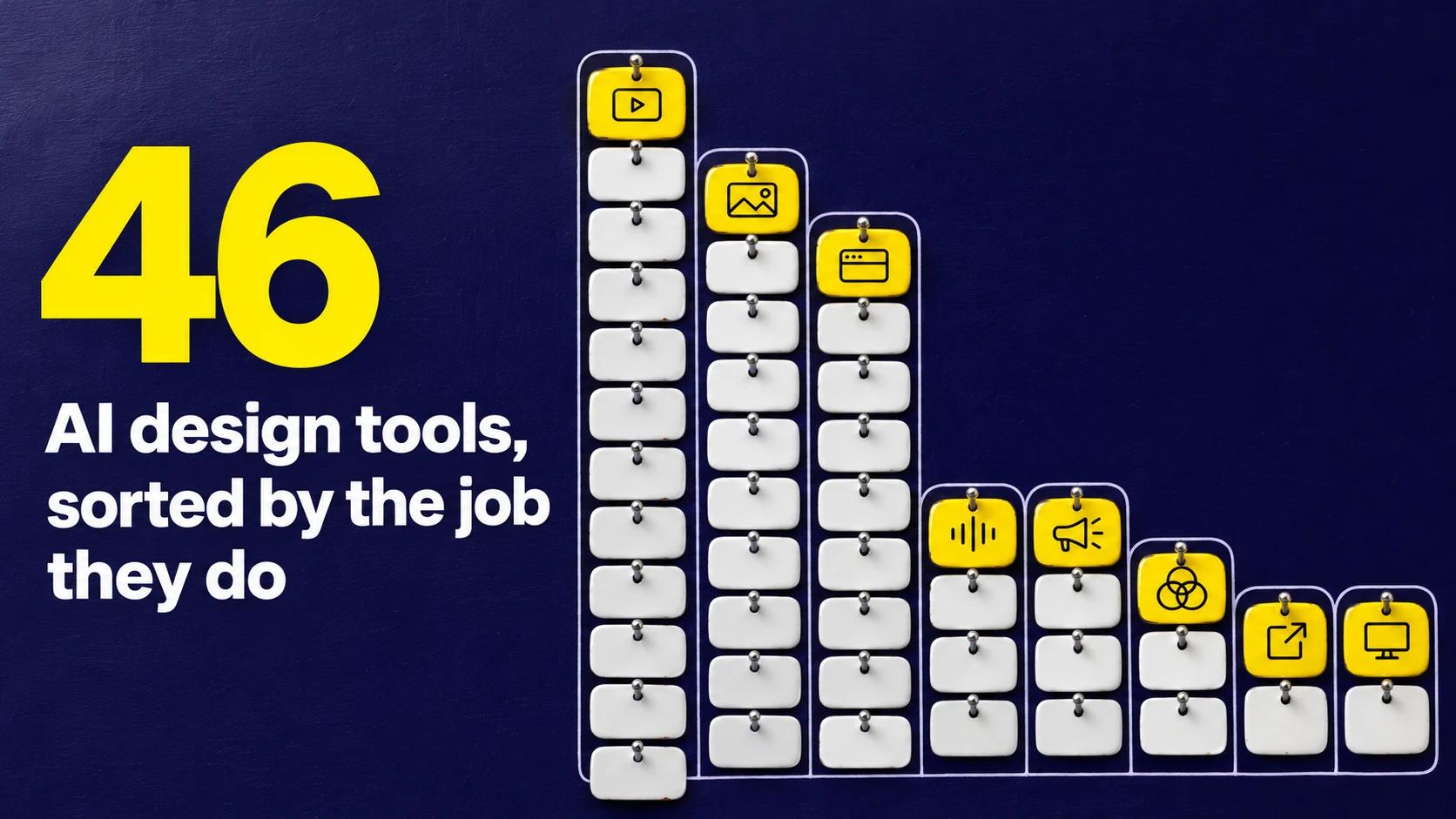
So we rebuilt the list from scratch. These are the 46 AI design tools we think are worth your time in November 2026, sorted by the job they do, including the Chinese models that now rank among the best for video. For each one you get what it does, who it suits, and one honest limitation. We checked every tool against its own website this month, and we left out prices because they change too often to print.
If you came here for the single best AI design tool, the honest answer is that there isn't one. There's a best tool for each job, and most real design work needs three or four of them together.
What counts as AI design software now
AI design software, sometimes called AI-powered design software, is any tool that uses generative or predictive models to make or change visual work: images, interfaces, video, sound, slides and logos. In 2023 that mostly meant typing a prompt and hoping. The better tools now let you edit one part of an image and leave the rest alone, keep a character the same across a campaign, or turn a sentence into a clickable prototype.
Two shifts matter most. First, the big platforms now host other companies' models. Adobe Firefly offers Google's and OpenAI's image models next to its own, and Krea, Higgsfield and Magnific do the same. Second, design tools have grown agents. In Figma, Canva, Framer and Gamma you can describe a change in plain language and watch the file update.
What hasn't changed is the need for someone with taste to decide what's good. Figma's CEO, Dylan Field, made the same point in a June 2026 interview with Stratechery. AI is trained on work that already exists, he argued, so the most distinctive work has to come from people pushing beyond it. We come back to that near the end, where we explain how our own studio uses these tools.
The best AI design software at a glance
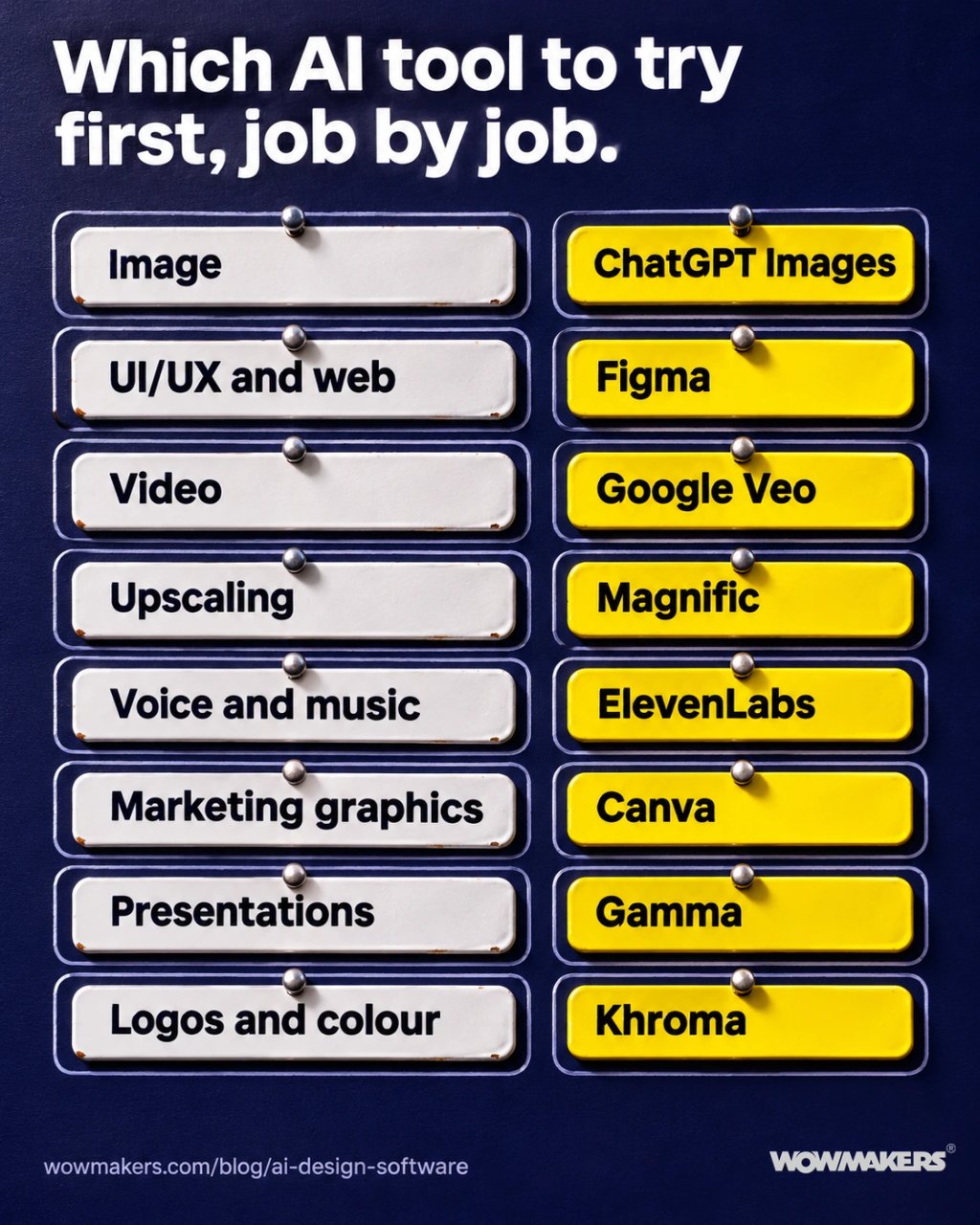
Short on time? Here's the whole list by job, with the tool we'd try first in each group.
| Job | Tools in this list | Try first |
|---|---|---|
| Image generation and editing | ChatGPT Images, Nano Banana, Midjourney, FLUX, Seedream, Adobe Firefly, Ideogram, Recraft, Krea, Leonardo | ChatGPT Images, with Nano Banana a close second |
| UI/UX and web design | Figma, Claude Design, Stitch, pen.dev, v0, Lovable, Framer, Relume, Attention Insight | Figma, if your team already designs there |
| Video | Gemini Omni, Google Veo, Seedance, Kling, Runway, Higgsfield, MiniMax Hailuo, Wan, Luma, Synthesia, HeyGen, Descript | Google Veo, for footage with native sound |
| Upscaling and finishing | Magnific, Topaz Labs | Magnific, for detail on finished frames |
| Voice and music | ElevenLabs, Sarvam, Cartesia, Suno | ElevenLabs for many languages, Sarvam for Indian languages |
| Marketing graphics | Canva, Adobe Express, Kittl, Designs.ai | Canva, for everyday on-brand graphics |
| Presentations | Gamma, Beautiful.ai | Gamma, for a first draft from a prompt |
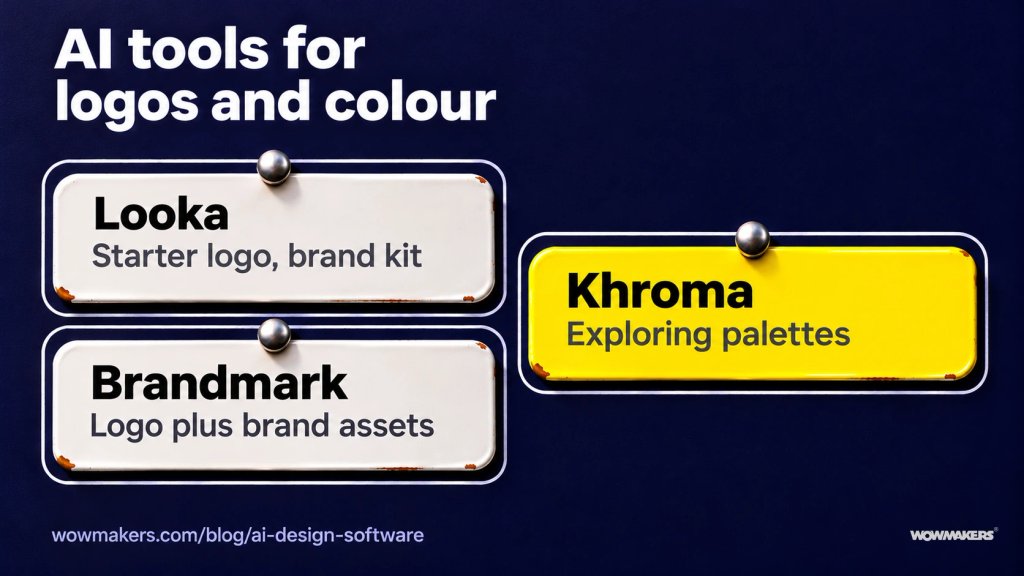
| Logos, branding and colour | Looka, Brandmark, Khroma | Khroma, for early palette exploration |
We picked these tools in three ways: what our studio uses, what ranks well in independent blind votes, and what practitioners and other well-known guides keep recommending. We checked every tool against its maker's own pages in November 2026, compared the image and video picks with Arena's public leaderboards, and read what people were posting in the communities listed near the end. We didn't run a formal side-by-side test, so the "try first" picks are our studio's judgement.
AI image generation and editing software
This is the busiest group, and the one where tools overtake each other every few months. Our current ranking puts ChatGPT Images first and Google's Nano Banana a close second, and on some briefs they swap places. Independent votes point the same way. On the Arena text-to-image leaderboard (formerly LMArena), as of 2 November 2026, OpenAI's GPT-Image 2.5 and 2.6 models hold the top five places, and Nano Banana 2.1 is Google's highest entry, in seventh.
ChatGPT Images (OpenAI)
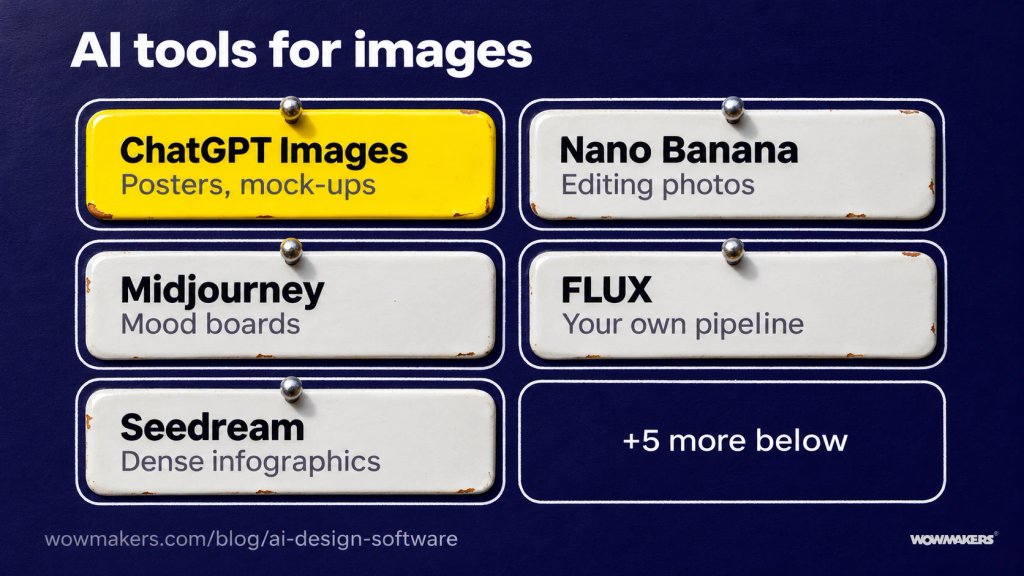
ChatGPT Images is our default first choice for image work right now, and it replaces DALL-E on this list. OpenAI released Images 2.6 on 4 November 2026. It generates images about 50% faster than the version before, turns a still or a rough sketch into a looping GIF, lets you mark up the exact spot you want changed, and adds SVG export. Developers get two API models, GPT-Image-2.6 Flare for speed and GPT-Image-2.6 Sunburst for detail and consistency across edits.
It's a good fit for marketers, founders and design teams who need posters, social graphics, concept images and quick mock-ups, which covers most of the image work in our studio. Remember that it's a chat window rather than a design tool. Final type and layout belong in Figma, Illustrator or Photoshop.
Nano Banana (Google Gemini)
Nano Banana is Google's name for the image models inside Gemini, and it's a close second in our ranking. On some briefs it takes first place. The newest model, Nano Banana 2.1, arrived on 6 October 2026 and is built on Gemini 3.6 Flash. It generates and edits images from plain instructions and keeps a character's look steady from one image to the next, and the Gemini app offers a "redo with Pro" option for a Nano Banana Pro pass. As of November 2026, Google lists Nano Banana 2 as free in Gemini, and Nano Banana 2.1 comes with a paid Google AI plan.
Reach for it when you edit more than you generate, such as swapping a background, changing the light, merging two photos or fixing a product shot. Google advertises 2K output. That's plenty for screens, but large print needs an upscaler such as Magnific or Topaz Labs.
Midjourney
Midjourney is our pick when the look matters more than precision. Its V8.2 model focused on aesthetics and personalisation, so the more images you rate, the better it learns your taste.
For mood boards and style frames it's hard to beat. That's how we use it. Its weak spot is control. Midjourney rewards exploration, and when a layout needs exact text or an exact product shape, a model built for editing gets there with less fighting.
FLUX (Black Forest Labs)
FLUX is the model family from Black Forest Labs. FLUX 3 launched in early access in July 2026 as one model that learns from images, video and audio together. In October the company released FLUX 3 Image Klein, a 5.6-billion-parameter open-weights model for generation and editing with up to 10 reference images. Its licence allows free commercial use for individuals and companies with annual revenue under $5 million; larger companies license it or use the API.
It's a good base for studios and product teams that want to build image generation into their own pipelines, and for anyone who values realism and strong text rendering over a signature style. Most designers will meet FLUX inside another app, such as Krea, Firefly or Higgsfield, and those apps don't always carry the newest version. Check which version you're getting.
Seedream (ByteDance)
Seedream is ByteDance's image model family, and Seedream 5.0 Pro is the current flagship. ByteDance describes it as a multimodal image model with advanced reasoning, and its example gallery leans on dense infographics, multilingual posters and edits marked up directly on a photo. It ranks 16th on Arena's text-to-image leaderboard as of 2 November 2026, with more than 100,000 votes behind that place.
It suits e-commerce and content teams producing information-heavy visuals in volume. Outside China most teams reach it through platforms such as Higgsfield, so the platform's terms decide where your uploads go. Read them before client work.
Adobe Firefly
Adobe Firefly is Adobe's AI workspace for images, video, audio and vector graphics. Next to Adobe's own Firefly Image 5 model, it offers partner models from Google, OpenAI, Black Forest Labs and others, and it powers editing features such as Generative Fill.
It suits teams already working in Photoshop and Illustrator who care where training data came from. Adobe says its own Firefly models are commercially safe because they're trained on licensed Adobe Stock and public-domain content. That claim covers Adobe's models, not the partner models in the same menu, so check which model made an image before it goes into a client campaign.
Ideogram
Ideogram made its name on text inside images, and that's still its edge. Its newest model, Ideogram 4.5, promises "readable type in every layout", and the platform now bundles image and video models from other labs plus small apps for jobs like background removal and resizing. It has also added Ideogram Vector, which turns a prompt or an image into an editable SVG.
It's made for posters, thumbnails and ad variations where the words must be spelled right. Readable type isn't typeset type, though. Kerning, hierarchy and brand fonts need a designer's pass.
Recraft
Recraft generates images, vectors and mock-ups, and its standout feature is editable vector output. Most generators hand you pixels. Recraft can hand you vector graphics you can open and adjust, and its current models belong to the V4 family.
Illustrators, icon designers and brand designers get the most from it, especially for assets that have to scale cleanly. Treat the vectors as a draft. Paths and anchor points usually need cleaning up before anything enters a brand system.
Krea
Krea is a creative workspace that puts many models in one place. Alongside its own Krea models, it hosts FLUX, Nano Banana and video models from ByteDance, Alibaba and others. It adds real-time generation, an upscaler it calls Enhancer, custom style training and a node editor for building workflows.
Use it if you want to compare models side by side without juggling separate subscriptions. The menu changes constantly. What you can do on any given day depends on which underlying model you pick, and the line-up rarely stays the same for long.
Leonardo
Leonardo survives from our 2023 list and has grown into a creative suite for images and video. It has its own models, such as Lucid Origin and Lucid Realism, supports custom models tuned to your aesthetic, and aims squarely at brands producing campaign content at scale.
It suits marketing teams and game or product studios that need many variations in one style. The difficulty is crowding. Leonardo now competes with Krea, Firefly and Magnific on almost every feature, so choose it for its workflow rather than for a model you can't get anywhere else.
AI software for UI/UX and web design
This group changed the most. In 2023 the interface tools on our list were mostly promises. Today you can describe a screen and get an editable design, a working prototype, a published website or a full working app.
Figma (Figma Make and the Figma agent)
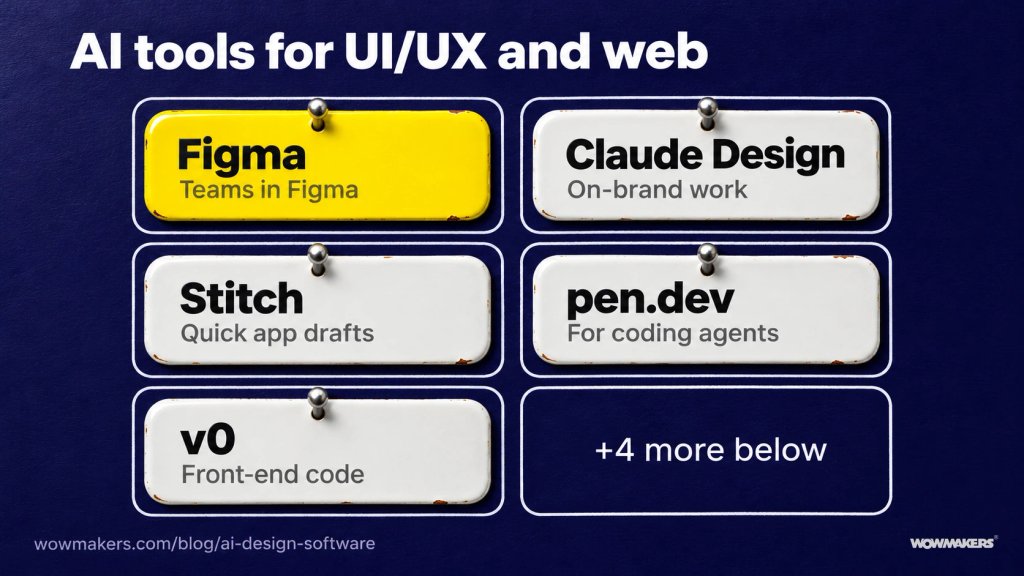
Figma has built AI into most of its product. The Figma agent can generate design directions, create diagrams, edit images and search your files. Figma Make turns a prompt into a code-backed prototype that stays visually editable, and Figma's MCP server passes designs to coding agents. It works in reverse too. In February 2026, Dylan Field announced that screens built in Claude Code can come into Figma as editable layers. Teams pay for AI use through shared AI credits. At its first Config India in October 2026, Figma said India is now its second-largest market by daily active users, and announced an MCP partnership with Sarvam.
For product teams already designing in Figma, it's the obvious first stop. The risk is that speed skips the thinking. A prototype that appears in a minute still needs research, user flows and real content behind it, or you've only built the wrong thing faster.
Claude Design (Anthropic)
Claude Design is an Anthropic Labs product for making designs, interactive prototypes, slides and one-pagers in conversation with Claude. During setup it builds a design system for your team by reading your codebase and design files, then applies your colours, type and components to each new project. Work exports to PowerPoint, PDF or HTML, goes to Claude Code as a handoff, or moves to connected apps such as Canva.
It suits product managers, founders and marketers who need on-brand visual work without waiting in a design queue, and designers who want to try more directions than a deadline usually allows. It learns your brand from what you feed it, so a team without a codebase or a documented design system will get less consistent results.
Stitch (Google, formerly Galileo AI)
Stitch is Google's tool for turning a text prompt into UI designs for mobile and web apps. It grew out of Galileo AI, which sat on our 2023 "coming soon" list, and the old Galileo address now redirects to Stitch.
Founders and product managers can get a quick visual draft of an app idea before they brief a designer. The trade-off is sameness. Prompted interfaces lean towards familiar patterns, which is fine for a first draft and wrong for a brand that needs to stand apart.
pen.dev (formerly Pencil)
pen.dev is a design canvas built for working with AI agents. You can design with agents on the canvas or edit by hand, and it connects to coding agents such as Claude Code and Cursor through MCP. It imports from Figma and HTML, and exports frames as HTML with CSS or Tailwind.
It suits designers who work closely with developers and want design files that coding agents can read. It's also very new. Its maker announced the launch in January 2026 and it has already changed its name once, so keep important work backed up somewhere you control.
v0 (Vercel)
v0 is Vercel's AI agent for building real code from a prompt. It turns wireframes and mock-ups into high-fidelity UIs, builds landing pages and dashboards, and goes as far as full-stack apps connected to a backend. It can start from a screenshot or a Figma file, works with Next.js, Tailwind and shadcn/ui, and deploys to Vercel in one click or opens a pull request for review.
It suits designers and product teams who want working front-end code from a design, especially teams already on Next.js. The code follows v0's preferred stack, so a team on a different framework will rework more of it.
Lovable
Lovable builds full-stack apps and websites from a conversation. You describe a product or an internal tool, refine the design in chat, and Lovable handles hosting, SSL and the backend. It says your code and data stay yours.
Founders and non-technical teams use it to get a working product or internal tool quickly. Speed hides decisions, though. A generated app needs someone to review security, data handling and the user experience before real customers arrive.
Framer
Framer is a website builder with an AI agent inside it. Describe a page or a change, and the agent creates editable pages, sections, copy and visuals in your project. It also works with the CMS, builds custom code components, and can review a site for contrast problems, typos, missing alt text and SEO gaps before you publish.
It suits designers and marketing teams who want to design and ship marketing sites without waiting on a developer. Framer is built for marketing websites, though. A complex web app with user accounts and heavy data belongs in a different stack.
Relume
Relume starts a website from the plan rather than the pixels. Give it an old site, a document or a few notes, and it produces a brief, a sitemap, wireframes and a style guide, then assembles pages from its component library. You can publish on Relume or take the work into Figma, Webflow or React.
Web agencies and freelancers who build many marketing sites will save the most time on structure. Because everything comes from one component library, sites can end up looking related unless a designer pushes the visual layer further.
Attention Insight
Attention Insight predicts where people will look on a design before anyone sees it. Its model is trained on real eye-tracking data, and it produces attention heatmaps plus clarity and focus scores for websites, ads, product screens and short videos.
It helps when you need to defend a layout to stakeholders with something firmer than taste. Keep in mind what it measures. A heatmap predicts attention, which says nothing about whether people understood the page, so pair it with usability testing before you call a design finished.
AI video software
Video has moved fastest of all. The leading models now generate sound along with the picture, several make 15 or 30 seconds in one pass, and the better platforms let you direct the camera instead of hoping for a good angle. The field is open. On Arena's text-to-video leaderboard, updated 21 September 2026, Google's Gemini Omni models hold the top two places, and Chinese labs hold four of the top eight. One warning before you build a workflow around any single tool: OpenAI closed the Sora app in April 2026 and its API in September 2026. Keep your scripts and source files somewhere you control.
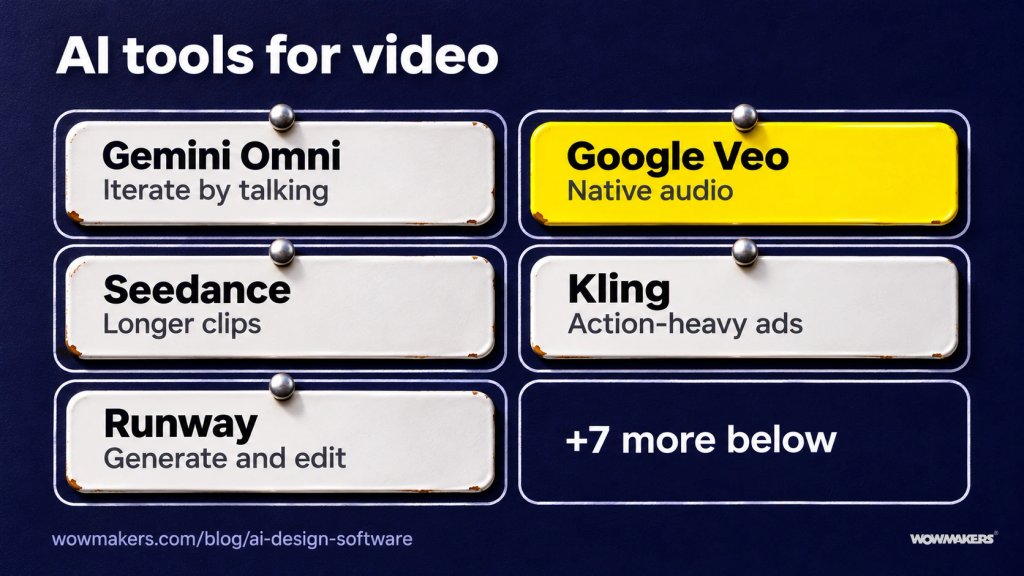
Gemini Omni (Google)
Gemini Omni is Google's newer model for making and editing video through conversation. Gemini Omni 1.2 Flash, released on 5 November 2026, makes clips of 3 to 15 seconds, lets you fix a detail with a follow-up edit instead of regenerating the whole clip, and upscales finished shots to 1080p or 4K. It runs in Google Flow and is now generally available on Google Cloud.
It suits teams making social ads and product explainers who want to iterate by talking to the model. Fifteen seconds is short, though. A longer film means stitching clips and keeping characters consistent across them.
Google Veo
Veo is Google DeepMind's video model, and Veo 3.1 is its latest version. It generates video from text or images with native audio, including sound effects, ambient noise and dialogue. You can use it in the Gemini app, in Google Flow, or through the API.
It suits filmmakers, agencies and brand teams making ads, product films and concept shots, and we use it in our own AI film work. The limitation is one every model here shares. Long, consistent sequences still take many generations and a patient editor.
Seedance (ByteDance)
Seedance is ByteDance's video model. Seedance 2.5, launched on 31 July 2026, generates audio-video clips of up to 30 seconds in one pass and can extend them in further rounds. It accepts up to 30 images, 10 video clips and 10 audio clips as references, and lets you edit at specific timestamps. Outside China, ByteDance sells it through its BytePlus cloud, and platforms including Runway's API and Higgsfield host it.
It suits agencies and creators making longer, reference-heavy pieces, such as talking-character clips and product stories. All those reference slots are powerful and easy to overload. Consistency depends on a few clean, well-chosen references.
Kling (Kuaishou)
Kling is the video and image platform from Kuaishou Technology. Kuaishou announced the full launch of Kling 4.0 on 16 October 2026. It focuses on steadier large-scale motion and complex camera moves, generates up to 30 seconds in a single pass, outputs up to 10-bit HDR, and takes up to 15 reference assets and 10 keyframes. Its image model, Kling Image 3.0, produces native 4K stills.
Reach for it for action-heavy ads, music videos and cinematic shots with lots of movement. You may already have access through platforms such as Higgsfield or Adobe Firefly. Those platforms often run an older Kling version than Kling's own site, so check before you judge the model.
Runway
Runway was on our 2023 list as a video tool with AI features. It's now a creative suite for generating and editing video, images and audio in one browser workspace, built on its own models. Its current video model is Gen-4.5.
Creative teams who want generation and editing in the same place will feel at home. It's also a deep tool, so expect a learning curve before results look directed rather than generated.
Higgsfield
Higgsfield is a creative platform built on other companies' models. It hosts Google Veo 3.1, Kling, ByteDance's Seedance 2.5 and Seedream 5.0 Pro, Nano Banana Pro and GPT Image, among others, and wraps them in tools a director would recognise: camera controls, Cinema Studio 4.0 for cinematic scenes, a character tool called Soul, and hundreds of presets for short-form video.
It suits social and performance teams who need volume and a polished look quickly, and we use it for moving shots too. Be careful with the presets. Trend-driven effects date quickly and can make a brand look like everyone else on the feed.
MiniMax Hailuo (H3)
MiniMax H3 is the third generation of MiniMax's Hailuo video models. It works from text, images, video and audio together and generates video with native stereo sound, up to 15 seconds at 2K. MiniMax released it as open weights under its own community licence in August 2026, and you can also try it in the Hailuo app.
It suits studios that want a strong video model they can run on their own hardware. Running a video model of this size yourself takes serious GPU capacity, and the licence has its own terms. Read it before commercial use.
Wan (Alibaba)
Wan is Alibaba's video model family. Wan 3.0 generates native 30-second clips, takes up to 20 reference assets, can turn documents and web pages into video, and edits by instruction. Earlier versions, Wan 2.1 and 2.2, are open weights under the Apache 2.0 licence.
It suits teams turning existing material, such as decks, documents and product pages, into explainer-style video. If you need open weights, you're on the older 2.x line. Arena lists Wan 3.0 as proprietary, available through Alibaba's own services and API.
Luma
Luma, also on our 2023 list, now runs a creative agent that researches, generates and refines work across video, image, audio and text. Its Ray3.2 video model gives control over individual frames and continuity across cuts, and its Uni-1 model carries style and character references into new assets.
Try it if you want an agent to run a whole creative workflow while staying close to a brand's look. Agent workflows are new everywhere. Check each step.
Synthesia
Synthesia makes presenter-led videos with AI avatars, voiceovers and motion graphics from a script or source material, and it translates them into more than 140 languages, which is why teams lean on it for training, onboarding and sales enablement.
It's built for training, HR and internal communications teams who need many consistent videos without booking a studio. Avatars are fine for information. For a brand story that has to move people, they fall flat.
HeyGen
HeyGen creates avatar videos, including a digital version of you, and translates video with matching voice and lip sync across more than 175 languages and dialects.
It suits founders, sales teams and creators who want to appear in many videos, or in many languages, without filming each one. Get consent in writing. A convincing digital double needs clear permission and disclosure, whoever's face it is.
Descript
Descript edits video and audio through a transcript. Delete a sentence from the text and it disappears from the recording. Its AI editor, Underlord, can turn a raw recording into a tight first cut.
Podcasters, marketers and anyone cutting talking-head content will get the most from it. It's weaker for image-led pieces, where the pacing lives in the pictures.
Planning an AI film? See how a design studio directs one, frame by frame.
See our work
Chinese AI models worth knowing
Five of the tools above come from Chinese companies: Seedream and Seedance from ByteDance, Kling from Kuaishou, Hailuo from MiniMax, and Wan from Alibaba. Two more deserve a mention. Alibaba's Qwen-Image 3.0 is built for knowledge-heavy visuals such as multilingual product posters and storyboards. Tencent released Hy Image 3.5 as a preview in September 2026, with a focus on accurate text rendering.
They're here because they're good. On Arena's text-to-video leaderboard, updated 21 September 2026, Chinese labs hold four of the top eight places.
For a business outside China, the practical questions are the ones we'd ask of any vendor. Where are your uploads processed and stored? Do the terms let the provider train on them? What does the licence say about commercial use? Access usually comes through an international route. ByteDance sells Seedance through its BytePlus cloud, Kling runs a global site, and platforms such as Higgsfield, Krea, Runway's API and Adobe Firefly host several of these models under their own terms.
Open weights give you another option. MiniMax H3 and the Apache-licensed Wan 2.x models can run on your own hardware, so client material stays with you. Qwen-Image 2.1 also has open weights, but its licence covers research and evaluation only, and production use goes through Alibaba's paid API. For confidential launches and regulated clients, we choose the route first and the model second.
AI upscaling software
Generators often deliver at screen resolution. When an image or clip has to hold up on a billboard, a 4K master or a print run, an upscaler adds real detail instead of stretching pixels.
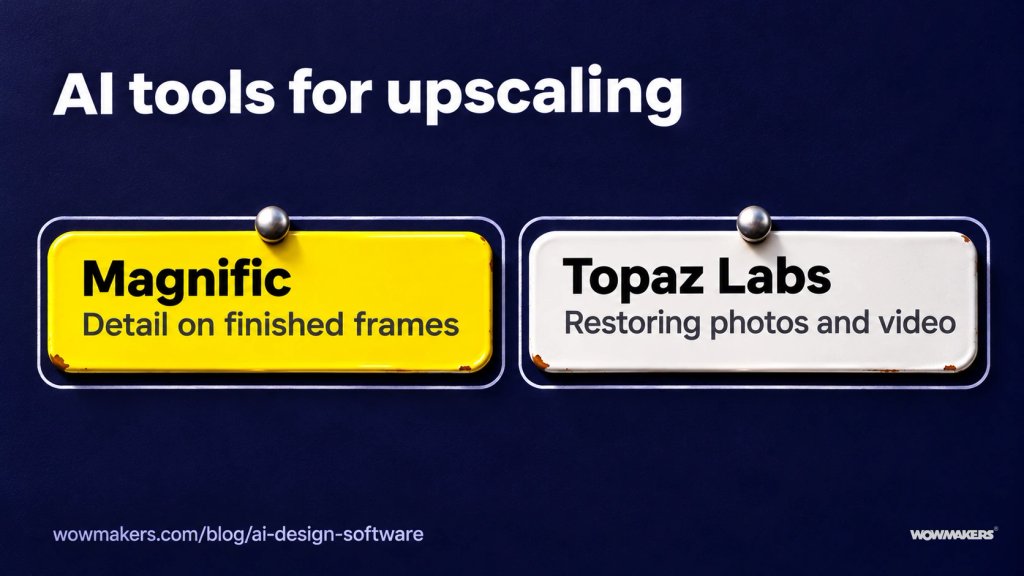
Magnific (formerly Freepik)
Magnific is best known as an AI upscaler that adds fine detail as it enlarges an image. Freepik has since renamed itself Magnific, so the name now covers a full creative platform too: image, video and audio generation from many models, image and video upscaling to 4K, and shared spaces for teams.
It suits anyone finishing AI images for large formats, and teams who'd rather keep generation and upscaling in one place. We use it for detail on finished frames. Creative upscaling invents detail that wasn't there, so faces, logos and product labels can shift slightly. Compare against the original before delivery.
Topaz Labs
Topaz Labs makes desktop, web and mobile apps that sharpen, clean up and upscale photos and video. Topaz Gigapixel upscales images up to 16 times their pixel count, and Topaz Video handles upscaling, frame interpolation, slow motion and SDR to HDR conversion.
It suits photographers, editors and video teams restoring old footage or finishing AI clips. It's a finishing tool. A weak shot stays weak, only sharper.
AI voice and music software
Sound carries half of most video, and AI voice is now good enough that the harder question is which voice fits the brand.
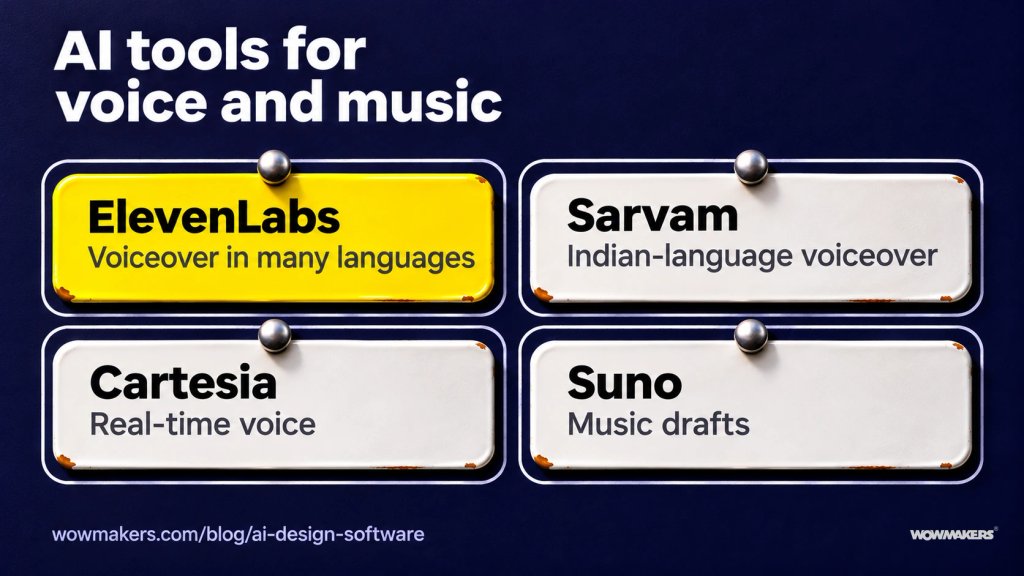
ElevenLabs
ElevenLabs covers most of the audio stack. It offers text to speech, voice cloning and voice design, dubbing that carries the original speaker's performance into other languages, music, sound effects (its SFX v3 model arrived in October 2026) and transcription. Its newest speech model, Eleven v4, is pitched as its most emotive yet.
It's a strong fit for video teams, e-learning producers and anyone who needs voiceover in many languages, and we use it for voice in our AI films. Direction is the limitation. A stock AI voice reads a script, and getting the right emphasis on the right word takes the same patience as directing an actor.
Sarvam (Bulbul and Sarvam Studio)
Sarvam is an Indian AI company building models for Indian languages. Its Bulbul text-to-speech models speak 10 Indian languages plus English, and the newest, Bulbul v4 Flash, offers more than 200 voices, though Malayalam and Odia aren't on v4 Flash yet. For video, Sarvam Studio dubs content into Indian languages, clones the original speaker's voice across versions, and lets you review the transcript and translation line by line before export. As of November 2026, Sarvam offers the first 30 minutes of dubbing free.
It suits brands making regional-language voiceovers and dubbed versions of films, training and product videos for Indian audiences. We make regional-language versions for clients, and this is the kind of tool built for that work. A native speaker should still check every line, because translation can miss idiom and tone even when the voice sounds right.
Cartesia
Cartesia builds real-time voice models. Its Sonic text-to-speech model is built for speed, it supports speech in 44 languages, and the company also runs voice agents for phone calls.
It suits product teams building voice features, and studios that want a second voice engine to compare against. We keep it in our kit for that reason. Its site centres on developers and real-time agents, with no music or sound-effects tools, so creators will find it narrower than ElevenLabs.
Suno
Suno generates complete, original songs from a text prompt.
It suits video teams who need a music draft to cut against, and creators who need original background tracks. We use it for exactly those drafts. Before a track goes into client work, check your plan. Suno says songs made on its paid plans are yours to keep and use, with full commercial rights on the Pro plan. Free songs don't get that.
AI tools for marketing graphics and social posts
For everyday marketing graphics such as social posts, flyers and ads, an editor with AI built in usually beats a raw image model, because templates, brand kits and one-click resizing do half the work.
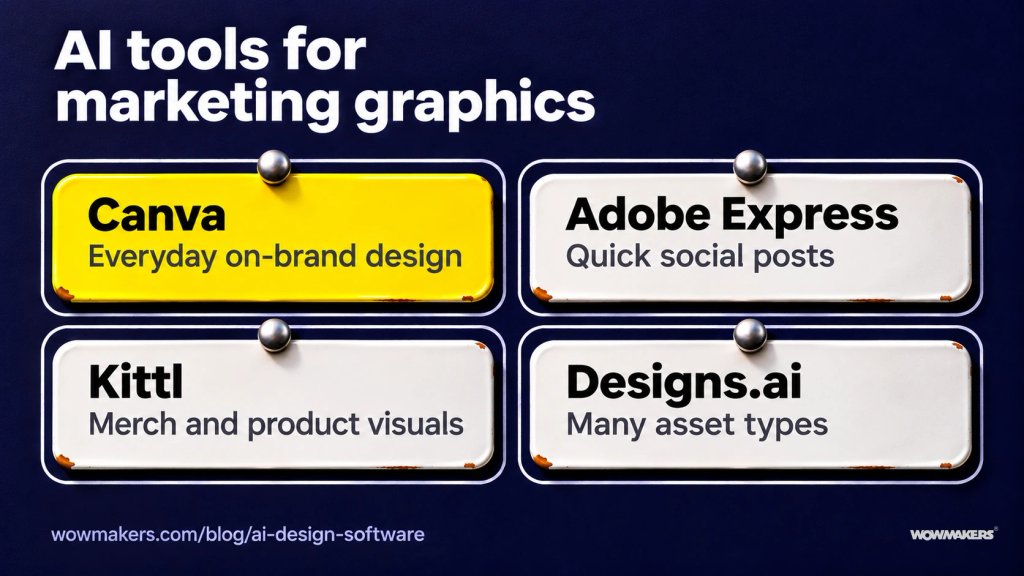
Canva
Canva launched Canva AI 2.0 in April 2026, and its in-house lab has since shipped its own models: Canva Craft, an image model released on 22 October 2026, and Canva Brush, a model that edits existing designs on request, released a week later. You describe what you need in conversation, and it builds layered designs you can edit piece by piece. Its Brand Intelligence feature applies your fonts and colours, and one brief can become content for several channels.
It's built for marketing teams and small businesses producing a lot of everyday design, from social posts to decks and documents. With so many teams starting from the same engine, work that never leaves the defaults starts to look familiar.
Adobe Express
Adobe Express is Adobe's quick-design app for social posts, flyers, short videos and presentations. Its AI features generate templates, images, text effects and logos, it resizes a design for every channel in one click, and the Premium plan adds brand kits. As of November 2026, Adobe lists a free plan with limited generative AI credits.
It suits marketing teams and small businesses who already work with Adobe. Its AI Assistant, which edits designs from a prompt, is still a limited beta for Premium users on desktop in US English.
Kittl
Kittl is a design platform for branding and product visuals. It has AI tools for images and editable vector artwork, a vectoriser that turns any image into scalable paths, ready-made templates, and AI workflows for merch, marketing and video.
It suits small businesses, print-on-demand sellers and agencies making merch and branded visuals. Templates and AI shortcuts make it easy to look like every other shop on the same marketplace, so start from your own brand assets.
Designs.ai
Designs.ai, from Pixlr, is a set of AI agents that plan and produce creative assets. A Brand Agent builds a visual identity, and other agents handle images, video, storyboards, slides and audio, with a logo design skill on top.
It suits small teams that want one subscription covering many asset types. Breadth is the point and the weakness, because a tool that does everything rarely matches a specialist on any single job.
AI presentation software
Slides are where many people first meet AI design. These two tools specialise in decks, building one from a prompt or an outline and keeping it on brand. Canva and Claude Design, covered elsewhere on this list, make slides too.
Gamma
Gamma builds presentations, documents, websites and social posts from a prompt, with an AI agent that helps you brainstorm, design and edit. It imports PowerPoint and PDF files. It exports to both, too.
Consultants, marketers and founders who need a clean deck fast will like it. Prompted decks tend towards the same tidy structure, though, so the argument and the order of ideas have to come from you.
Beautiful.ai
Beautiful.ai is built around Smart Slides, layouts that realign, resize and animate content as you edit. Its AI writes a first draft from your idea or outline, and brand controls lock colours, fonts and logos for the whole team. Decks export to PDF and PowerPoint.
Sales and marketing teams get every deck on brand without a designer checking each one. The trade-off is flexibility. Smart Slides keep you inside their layouts, which is the point, right up until you need a slide they didn't plan for.
AI tools for logos, branding and colour
AI logo makers are fine for a placeholder, a side project or a quick test of a name. A brand identity is a different job, because it starts with positioning, and that's where our branding work begins. The tools below help at the start of that process, or when a full identity isn't the need yet.
Looka
Looka generates logo options from your company name and preferences, lets you adjust colours, symbols and layout, and builds a Brand Kit with matching business cards, social profiles and more than 300 templates.
It's useful for new small businesses that need a usable logo and matching assets this week. Generated logos draw on common symbol and type patterns, so the checks for trademark conflicts and distinctiveness are on you.
Brandmark
Brandmark creates a logo for your business and extends it into starter brand assets: logo source files, a brand guide, business cards, social media designs and even a one-page website.
Solo founders get a logo and a starter identity in one go. Same caution as Looka. Treat the mark as a starting point, and check that it's distinct before you print anything.
Khroma
Khroma learns which colours you like and generates palettes to match. You train it by picking colours, then browse combinations as type, gradients, palettes or images. Each saved pair comes with hex and RGB values, CSS code and a WCAG accessibility rating.
Use it to explore palettes early in a project, especially for digital work where contrast matters. A palette that looks right in isolation still has to work with your photography, your product and your market.
How a design studio uses these tools
We've been designing since 2011. Here's how AI tools fit into that work today, with people directing every step.
Every project starts with a brief rather than a prompt. Before anyone generates a frame, we agree what the work has to do, who it's for and where it will run. Then our directors set the look with style frames and boards, most often made with ChatGPT Images and Nano Banana, plus Midjourney and FLUX, with Magnific for detail.
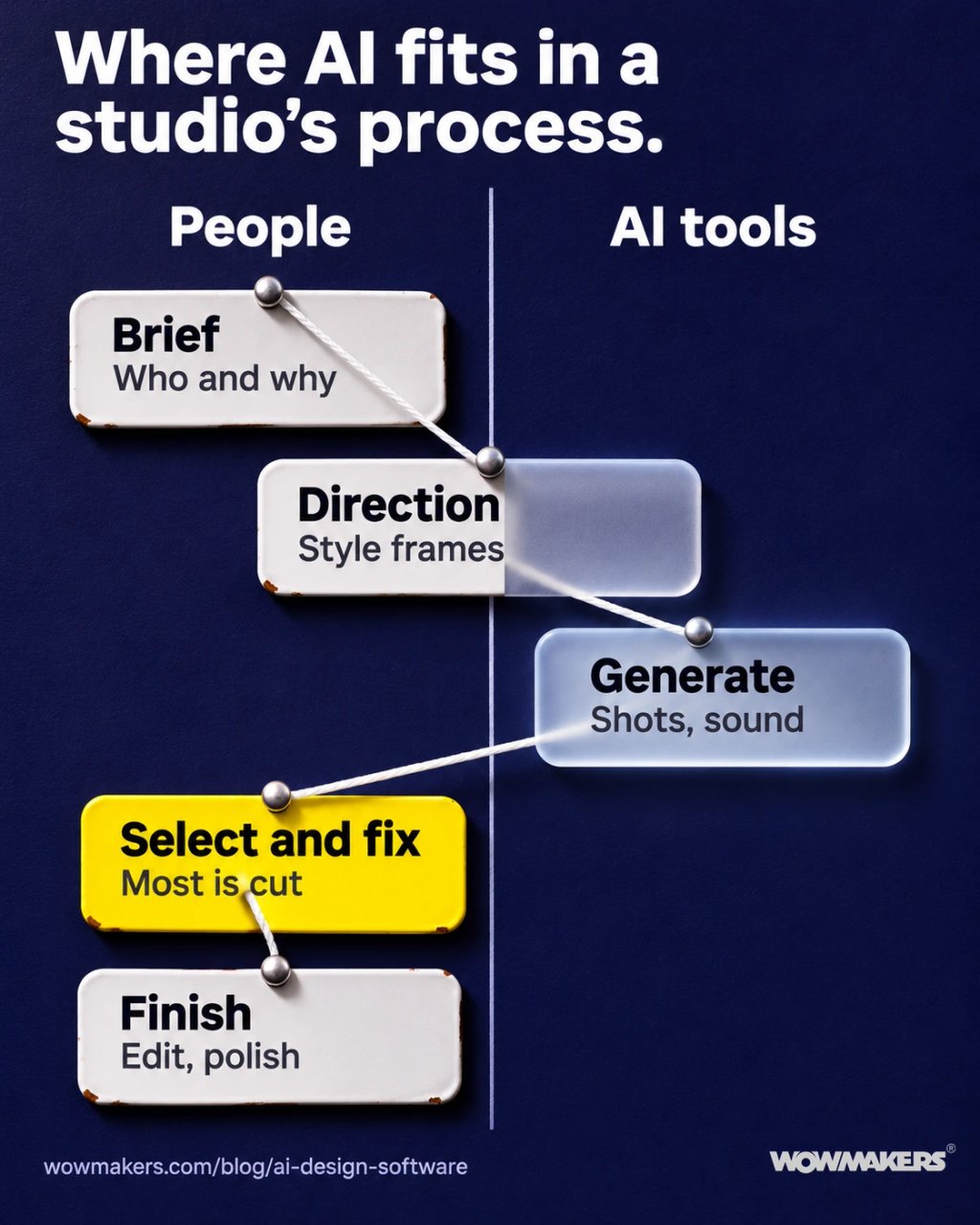
For moving shots, our AI video team works with Google Veo, Runway and Higgsfield. ElevenLabs and Cartesia handle voice, and Suno gives us music drafts. Script, direction, editing, mixing and the final polish stay with people.
Most of what the tools produce never ships. On one six-minute AI film for a technology group, the team ran about 1,500 generations and kept 69 shots. In one review pass, 58 of 74 frames failed and went back for another try. We expect that. The tools are fast at producing options. Choosing the right one is still the job.
In our experience, AI gets four things wrong most often: hands, on-screen text, faces and brand colours. We check every frame for them before anything ships.
The same thinking carries into product and brand work. In UI/UX design, prompt-to-prototype tools are a quick way to sketch an idea and put it in front of people. The research, the flows and the final decisions stay with designers. In branding, AI widens the search for directions, and human judgement chooses the one worth owning.

Want AI speed with designers still steering? Tell us what you're making.
Talk to us
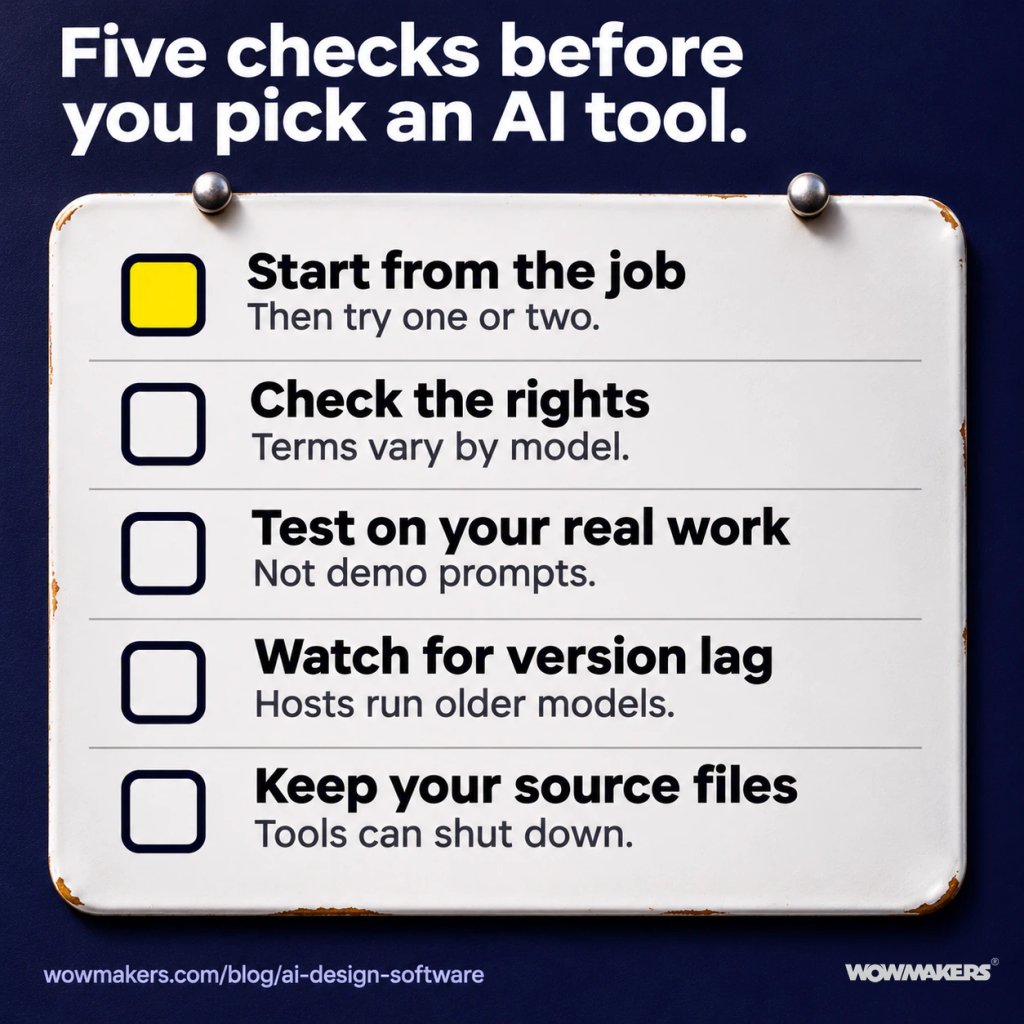
How to choose AI design software
- Start from the job. Pick the group above that matches what you need to make, then try one or two tools from it.
- Check the rights. Read each tool's terms on commercial use, and remember that a platform hosting many models may treat them differently.
- Test on your real work. A tool that shines on demo prompts can stumble on your product, your brand colours or your language.
- Watch for version lag. Platforms that host other companies' models often run an older version than the maker's own site.
- Keep your source files. Tools close, as Sora did in 2026, and prompts alone won't rebuild a project.
| Tool | Job | Best for |
|---|---|---|
| ChatGPT Images | Image | Our default for posters, social graphics and mock-ups |
| Nano Banana | Image | Editing photos while keeping the rest intact |
| Midjourney | Image | Mood boards and style frames |
| FLUX | Image | Building image generation into your own pipeline |
| Seedream | Image | Information-heavy visuals and infographics |
| Adobe Firefly | Image | Photoshop teams who care about training data |
| Ideogram | Image | Posters and thumbnails where the words matter |
| Recraft | Image | Editable vector illustration |
| Krea | Image | Comparing many models in one place |
| Leonardo | Image | Variations in one style at campaign scale |
| Figma | UI/UX | Product teams already designing in Figma |
| Claude Design | UI/UX | On-brand prototypes, slides and one-pagers |
| Stitch | UI/UX | A quick visual draft of an app idea |
| pen.dev | UI/UX | Design files that coding agents can read |
| v0 | UI/UX | Working front-end code from a design |
| Lovable | UI/UX | A working app or internal tool from a chat |
| Framer | Web | Designing and publishing marketing sites |
| Relume | Web | Sitemaps and wireframes for marketing sites |
| Attention Insight | UI/UX | Predicting where people will look |
| Gemini Omni | Video | Editing short clips by conversation |
| Google Veo | Video | Footage with native sound |
| Seedance | Video | Long, reference-heavy clips up to 30 seconds |
| Kling | Video | Action and complex camera moves |
| Runway | Video | Generation and editing in one workspace |
| Higgsfield | Video | Many top models with director-style controls |
| MiniMax Hailuo | Video | An open-weights video model you can host |
| Wan | Video | Turning documents and pages into video |
| Luma | Video | Agent-run creative workflows |
| Synthesia | Video | Training and internal videos with avatars |
| HeyGen | Video | Avatar videos and lip-synced translation |
| Descript | Video | Editing talking-head video through text |
| Magnific | Upscaling | Detail on finished frames |
| Topaz Labs | Upscaling | Restoring and sharpening photos and video |
| ElevenLabs | Voice and music | Voiceover and dubbing in many languages |
| Sarvam | Voice | Indian-language voiceover and dubbing |
| Cartesia | Voice | Real-time voice inside products |
| Suno | Music | Music drafts to cut against |
| Canva | Marketing graphics | Everyday on-brand design in volume |
| Adobe Express | Marketing graphics | Quick social posts and resizing |
| Kittl | Marketing graphics | Merch and branded product visuals |
| Designs.ai | Marketing graphics | Many asset types from one set of agents |
| Gamma | Presentations | A clean first draft of a deck |
| Beautiful.ai | Presentations | Decks that stay on brand across a team |
| Looka | Logos | A usable starter logo and brand kit |
| Brandmark | Logos | A logo plus starter brand assets |
| Khroma | Colour | Exploring palettes with contrast ratings |
Questions about AI design software
What is the best AI design software?
There's no single best tool. For images, ChatGPT Images is our first choice, with Nano Banana close behind. For UI/UX, start with Figma. For video, Google's Veo and Gemini Omni, with Seedance and Kling close behind, and for slides, Gamma. Most real projects combine three or four tools.
Can ChatGPT do graphic design?
It can produce a lot of graphic design's raw material. ChatGPT Images makes posters, social graphics and mock-ups, and since Images 2.6 it exports SVG and makes looping GIFs. It doesn't lay out a multi-page brand system or manage type the way Figma, Illustrator or InDesign do, so we use it for drafts and assets and finish the work elsewhere.
How much do AI design tools cost?
Prices change too often to print, so we left them out. Many tools on this list have a free tier or trial with tight limits, and paid plans often meter usage through credits, as Figma does with its shared AI credits. Check each maker's pricing page, and watch credit use on video tools, where long clips add up quickly.
Is there free AI design software?
Several tools have free tiers. As of November 2026, Google lists Nano Banana 2 as free in the Gemini app, Adobe Firefly has a free tier with daily generations, and Suno's free plan allows up to 10 songs a day. Free tiers come with tighter limits and sometimes fewer rights. Suno's free plan, for example, doesn't include commercial rights, so read the terms.
Will AI design software replace designers?
Our view, after using these tools on client projects, is no. They remove a lot of production time. They don't know what the work should say, which option is right, or when a frame is wrong, and someone has to make those calls.
Can I use AI-generated designs commercially?
It depends on the tool and the plan. Adobe says its own Firefly models are commercially safe, and Suno grants commercial rights on its paid plans. Check each tool's terms, and run trademark checks on anything that will become a logo or brand mark.
Where to keep up
These tools change month to month. These places are worth watching.
- r/StableDiffusion is the busiest place for open-weights image and video news, and often the first to test a model you can run yourself.
- r/aivideo collects finished clips that show what the closed video models can do.
- r/comfyui shares working node workflows for running image and video models on your own hardware.
- r/midjourney tracks style trends and prompts from Midjourney's large user base.
- The Arena leaderboards rank image and video models by blind votes, a useful check on launch claims.
- The Comfy Org Discord is the official ComfyUI community, good for help with a specific workflow.
- Hugging Face trending is where most open models are published, with their model cards and licences.
A note on this list
We checked every tool here against its own website in November 2026. AI design software moves fast, so expect names, versions and plans to keep changing. If you'd like help choosing the right mix for a project, talk to us.