Making a homemade explainer video is easier in 2026 than it has ever been. Template editors like Canva, Animoto, Powtoon and Vyond give you drag-and-drop scenes, stock characters and brand kits. AI tools go a step further. Synthesia and HeyGen turn your words into a presenter video, and Google Veo and Runway generate the footage itself.
Plenty of teams use them. In Wyzowl's State of Video Marketing 2026, a survey of 266 people in late 2025, 63% of video marketers said they had used AI to create or edit video, up from 51% a year earlier. We're in that group. Our studio uses Veo and Runway on client films.
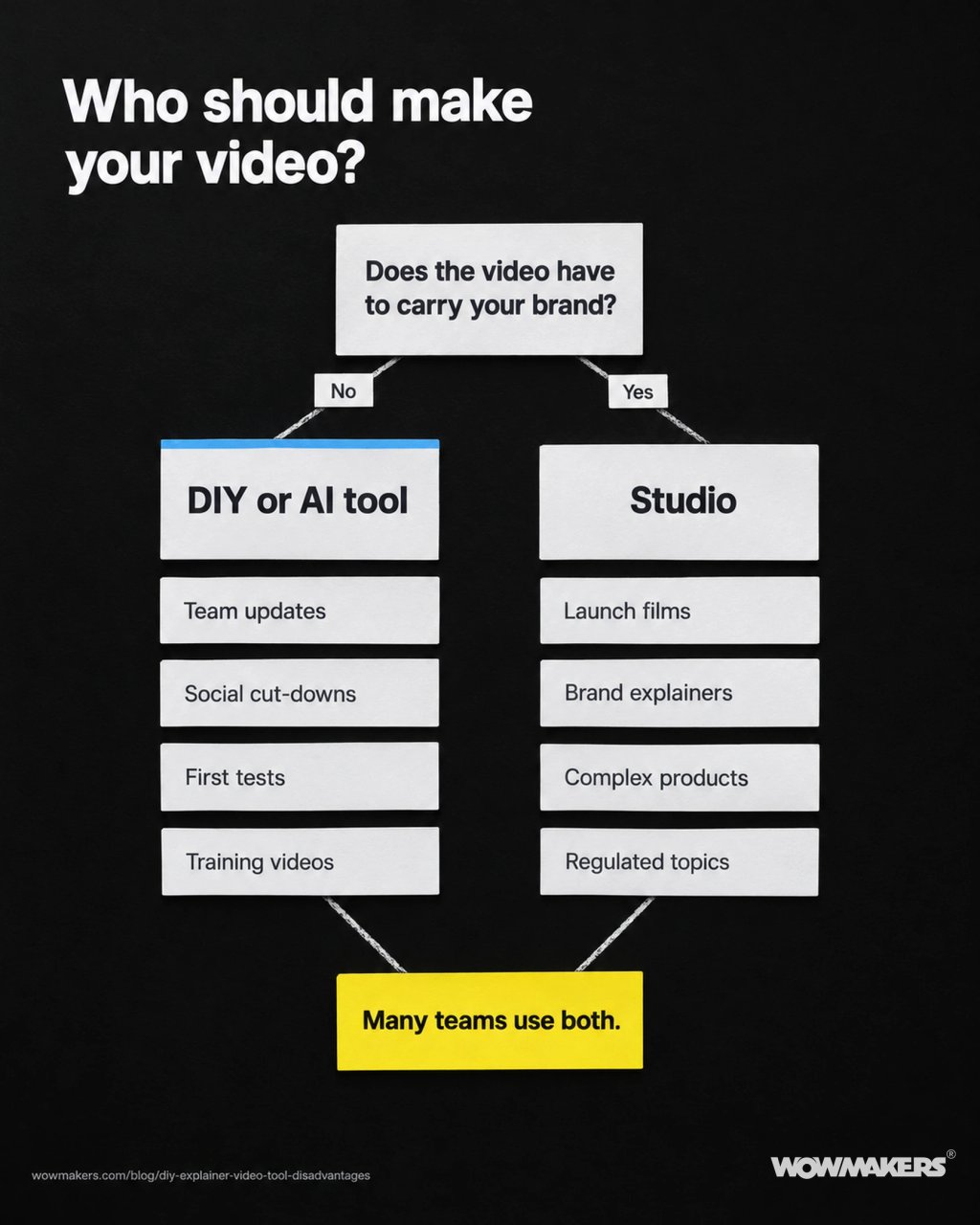
So the useful question is which videos you should make with a DIY tool, and which ones need someone directing them. The short version: use a tool for quick, internal, low-stakes video, and bring in a studio when the video has to carry your brand.
When to use a DIY or AI tool, and when to hire a studio
Use a DIY or AI video tool when:
- the video is for your own team, such as an internal update, a policy change or a meeting recap
- you need a quick social cut-down from a film or footage you already have
- the budget is small and the video is a first test, so speed matters more than polish
- you're making training or onboarding videos in several languages, and clarity is the bar
- you want a rough draft to brief a designer or a studio with
Hire a studio, or an explainer video expert on your own team, when:
- the video introduces your brand to buyers who haven't met you, like a homepage explainer, a launch film or a campaign
- the product is complex, and deciding what to show is the hard part
- you need one look held across many videos, cut-downs and languages
- a real person's face or voice appears on screen, or the subject is regulated, and someone has to own consent and accuracy
- your team's hours are worth more than the project fee
Many teams already split the work. Wyzowl found that 32% of video marketers mix in-house and outside production. A tool handles the weekly updates, and a studio makes the film that sits on the homepage.
What counts as a DIY explainer video tool in 2026
In 2017, a DIY explainer video tool meant a template editor with a library of cartoon characters. Two families of tools share the name now.
Template editors give you scenes, characters, music and transitions to arrange yourself. Canva's free video editor works on a drag-and-drop timeline and adds a brand kit on its Pro plan. Animoto is built around templates for social media videos and search ads. Powtoon covers animated presentations and whiteboard explainers, and Vyond makes animated and avatar video for business, with templates for eLearning and marketing. Most of them now bolt on AI features such as avatars and text-to-speech.
AI generators make the footage, the presenter or the voice for you. Synthesia turns documents, slides or links into presenter videos and translates them into more than 140 languages. HeyGen builds avatar videos, including an avatar of you, from a prompt. Google's Veo 3.1 generates video with sound and runs inside the Gemini app and Google's Flow. Runway is a suite for generating and editing video, images and audio in one place.
For a longer list of options, see our explainer video software roundup.
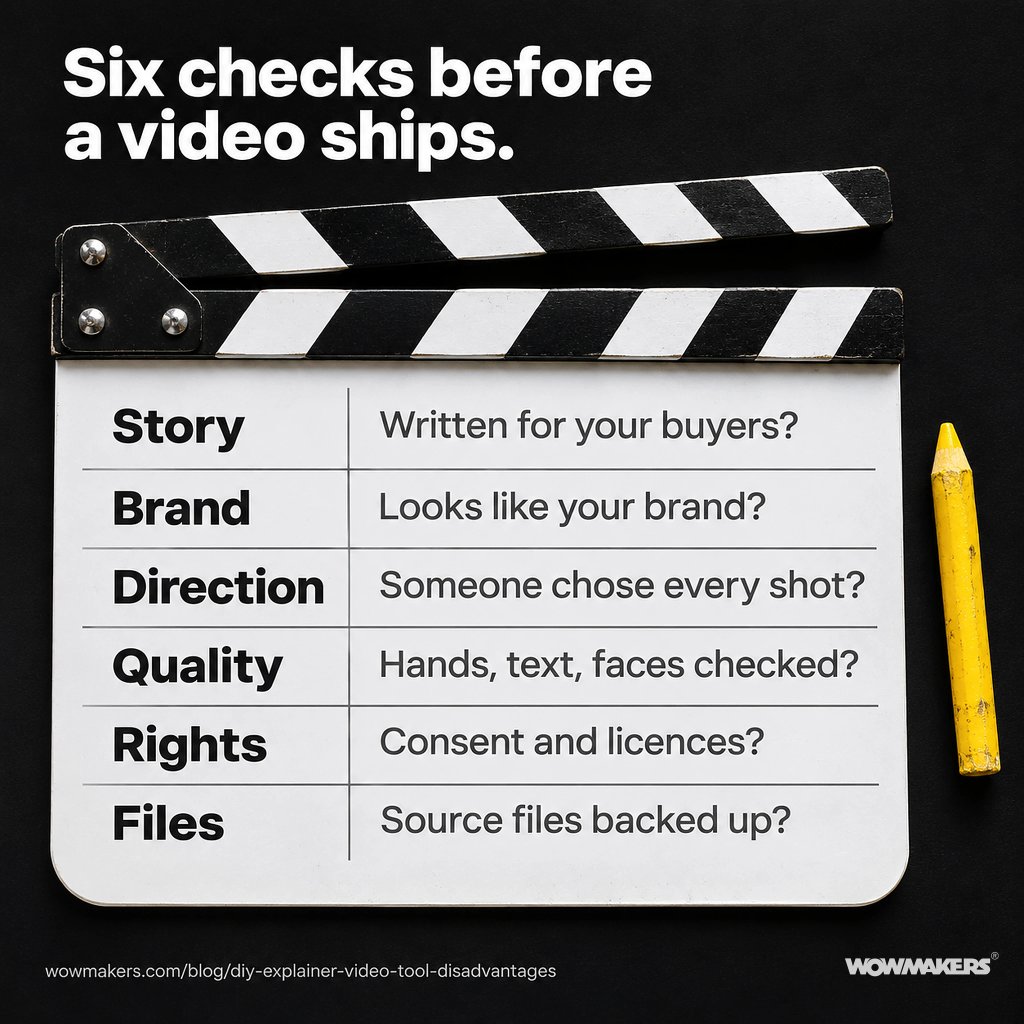
Six disadvantages of DIY and AI tools for a brand explainer
Each of these is a job the tool hands back to you. On an internal update you can skip most of them. On a brand explainer, they decide whether the video works.
1. The tool can't write your story
The hardest part of an explainer is deciding what to say: which problem to open on, which feature to leave out, and what the viewer should do at the end. A tool will happily turn your product document into a video, and Synthesia, for one, generates videos straight from docs, slides or links. You get your document back, read aloud by an avatar.
Viewers have seen a lot of these. Wyzowl's 2026 survey found that 96% of people have watched an explainer video to learn about a product or service. Standing out in that pile takes a script written around how your buyers think and decide, which a template can't supply. We wrote more about that in our post on explainer video psychology.
2. Your brand starts to look like the tool's defaults
Template editors share their libraries with every other user, and Powtoon's homepage counts more than 118 million Powtoons made. Brand kits help. Canva's lets you lock in your colours, fonts and logo. But a brand also lives in how things move, how characters are drawn and how fast a scene cuts, and those still come from the template.
AI generators drift in a different way. Each shot is a fresh generation, so a character's face, a product's label or your brand colour can shift between scenes. The vendors know it: HeyGen and Google both list character consistency as a headline feature. Holding one look across a whole film is still work somebody has to do, shot by shot.
3. Nobody is directing
A director's job is mostly choosing which take to use, which angle, how long to hold a shot and where the music lands. A template makes those choices for you, the same way it makes them for everyone else. An AI generator gives you options, plenty of them, and leaves the picking to you.
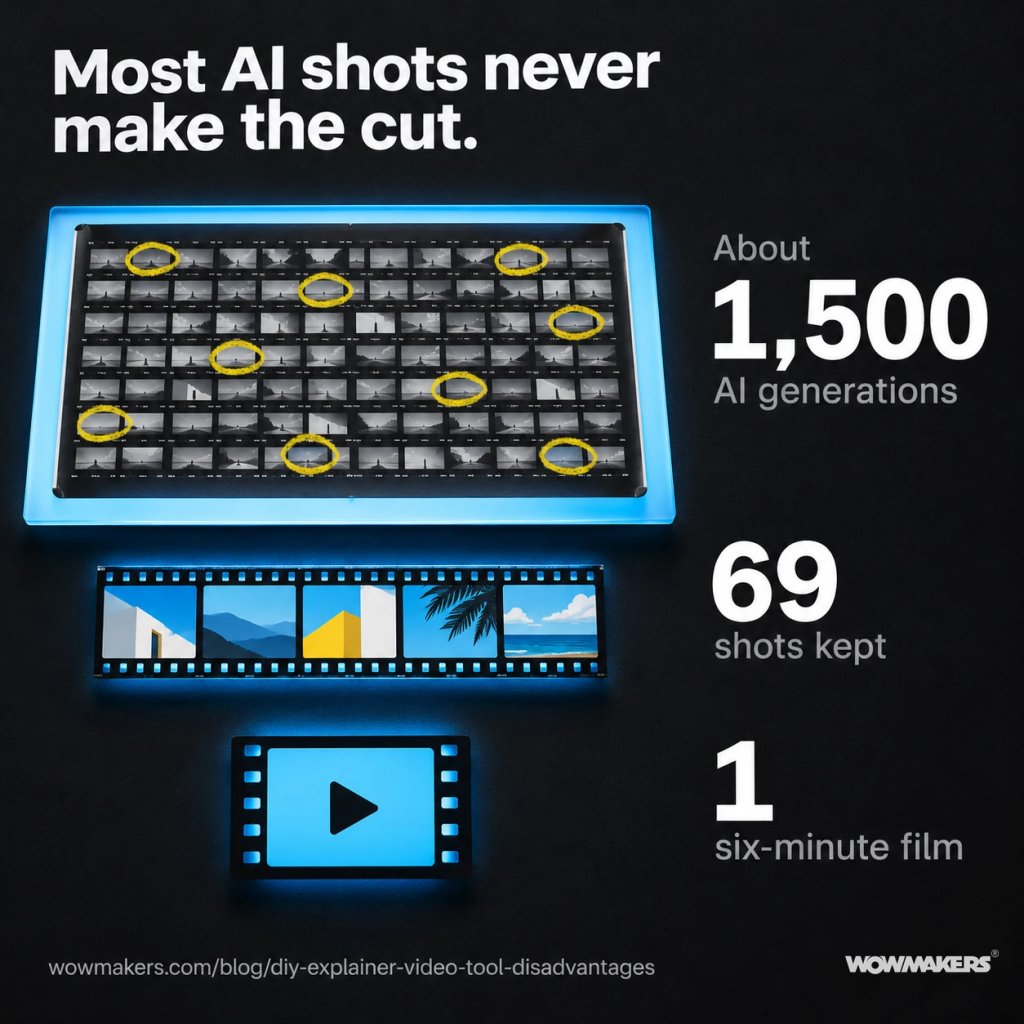
For a six-minute corporate film we delivered in October 2026, our team ran about 1,500 AI generations and kept 69 shots. A lot of the work on that film was choosing, and a DIY tool leaves that work with you.
4. Quality control lands on you
AI video still gets some things wrong, and they tend to be the things viewers notice first. Hands, on-screen text, faces and brand colours are the usual failures, along with the shape of a product and the words on its label. On that same six-minute film, one review pass failed 58 of the 74 frames we checked, and we sent every one of them back.
With a DIY tool, you are the review pass. For a team update, that's fine. On a film your buyers see, a garbled label or a six-fingered hand costs more trust than the tool saved in budget.
5. Rights, likeness and trust become your problem
Any real face or voice in the video needs that person's permission. Synthesia, for example, asks for a live, on-camera consent recording before it builds a personal avatar, so nobody can make an avatar of you without your say. Using an employee or a spokesperson needs the same care, in writing.
Copyright is the next question. In January 2025, the US Copyright Office concluded that AI output can be protected by copyright only where a human author has determined enough of its expressive elements, and that providing prompts alone doesn't count. Check the licence terms on any template music or stock footage before it runs in a paid ad, too.
Viewers also have their own view of AI. Gartner surveyed 1,539 US consumers in October 2025 and found that half would rather give their business to brands that don't use generative AI in consumer-facing messages, ads and content. Gartner's advice to marketers was to be open about when AI is used. We agree. We'd add that the generic AI look comes from default settings and unedited first generations, which is what a directed process is built to remove.
6. Revisions, and your hours, add up
A tool costs a subscription plus a lot of your team's time. Someone has to learn the tool, write the script, storyboard it, record or generate the voice and animate it, then redo half of that when a stakeholder asks for changes. A studio prices revision rounds into its quote. With a DIY tool, every round comes out of someone's week.
Tools also change under you. OpenAI shut the Sora app and website in April 2026, and its API in September 2026. If your video library lives inside one tool, keep the scripts, source files and masters somewhere you control.
How the three routes compare
| Template editor | AI generator | Studio that uses AI | |
|---|---|---|---|
| Examples | Canva, Animoto, Powtoon, Vyond | Synthesia, HeyGen, Veo, Runway | An AI-amplified studio like ours |
| Who writes the story | You | You, or a draft built from your document | A writer, working with you |
| Brand consistency | Brand kit covers colours, fonts and logo | Can drift from shot to shot | Look approved in style frames before production |
| Direction | The template's pacing | You prompt and pick | A director chooses every frame |
| Quality checks | You | You | The studio's team, then you |
| Rights and consent | Check music and stock licences | Consent for any real face or voice, plus the tool's terms | Part of the brief |
| Revisions | Your time | Your time, plus regenerating shots | Rounds agreed in the quote |
| Best for | Internal updates, social cut-downs | Training, updates, language versions, drafts | Brand explainers, launches, campaigns |
How we use AI inside a directed process
We're a design studio in Kochi, India, and we've made video for clients around the world since 2011. AI is part of how we make films now. Veo and Runway generate shots, and ElevenLabs and Suno give us draft voices and music. Our team keeps the script, the direction, the edit and the final call on every frame. Craft leads, and AI amplifies it.
Every film goes through the same five steps, whether it's a 15-second ad or a six-minute film: brief, script and look, AI generation, edit and polish, then delivery. You approve the script and the look before anything is generated, so the AI works to a style you've already signed off. If the brief isn't the whole story, we say so early. That's how our AI video production turns films around in days to a few weeks, with a director choosing every frame.
What does an affordable explainer video look like?
If you searched for a cheap or low-cost explainer video, a DIY tool is the lowest cash cost. You pay for it in hours, and in the six gaps above. Between a DIY tool and a full studio project, you still have options:
- Write a shorter script. Studios usually price per second, so a 60-second video costs less than a 90-second one, and it often holds attention better.
- Pick a simpler style. Whiteboard animation is usually the leanest studio format.
- Ask for AI-accelerated production. The same creative direction with AI in the pipeline costs less and takes weeks off the schedule.
- Plan for reuse. One master film can be cut down for social, ads and other languages.
Our explainer video cost guide lists typical prices by style and by production method. For more ways to stretch a small budget, read our post on video marketing on a low budget.

Weighing a tool against a studio? Send us the brief and we'll tell you which one fits, even when it's the tool.
Talk to us
Questions people ask about DIY and AI explainer videos
Are AI explainer videos good enough for marketing?
For some jobs, yes. Presenter videos for training, product updates and language versions work well when someone checks every frame. For a brand explainer, AI is a strong production method in the hands of a director. Left on default settings, it tends to produce the generic look viewers already recognise.
Is a DIY explainer video cheaper than hiring a studio?
In cash, yes. The total cost depends on whose time goes into it and how many people see the result. A video for 20 colleagues and a video on your homepage carry very different costs when they come out mediocre.
Who owns a video made with an AI tool?
Read the tool's terms first. HeyGen, for example, says you own the videos you make with it. Copyright protection is a separate question: in the US, prompts alone don't make you the author of AI output. For anything high-stakes, ask a lawyer.
Making the video yourself? Use the six points above as your review list before you publish. Want a second opinion on the brief first? Talk to us.